Player wiki
The four acts
CRANKWORKS is not one game with bigger numbers. It is 4 games in one box, and each eats what the last one made.
The rule that governs all of it
What one act produces becomes what the next act consumes.
That is the only honest way to make a fresh start feel like progress rather than repetition. Your old resource is demoted to raw material, and you start counting in a new unit.
ACT I : THE WORKSHOP
Your arm, one machine, a number that climbs when you turn. Everything fits in one hand.
ACT II : THE NETWORK
You stop turning. You own workshops instead, and each one is the whole of act I shrunk to a single line.
ACT III : THE AUTOMATON
Your factories build factories. You place nothing by hand any more: you write a doctrine and you watch. This is the act you can lose.
ACT IV : THE GREAT MOVEMENT
Everything you built becomes the parts of one mechanism — and you take the crank back. One turn costs hours of the swarm's work.
At every crossing three things change at once: the main screen is replaced, not reorganised; the counter at the top changes unit; and the verbs change — you stop cranking and start supplying, you stop supplying and start delegating. Three things deliberately do not change, or you would start over lost rather than better equipped: the meta crosses everything (cores, patents, the office, commissions, records — those are the better tools), the interface grammar stays the same, and the previous act keeps running underneath. Your act I machines are still making the energy act II burns.
Act II — The network
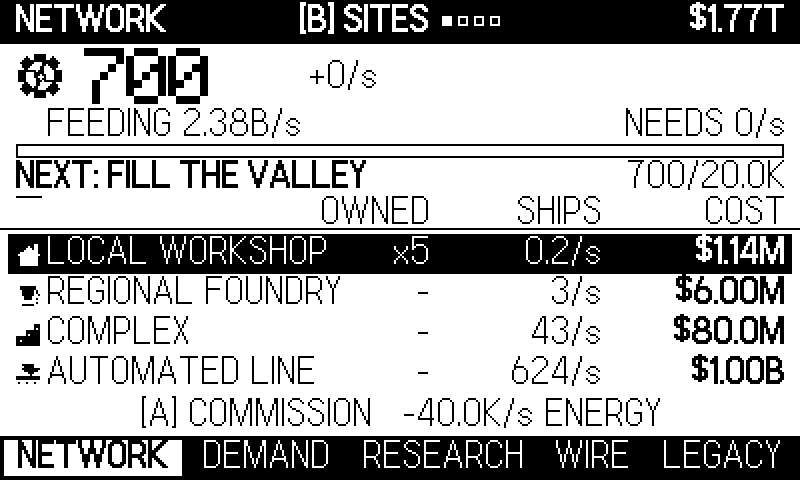
You stop turning anything. You own workshops, and each is the whole of act I reduced to one line. What you used to sell becomes what you burn. New resource: units. Energy is now an input. A site costs capital, eats energy per second, and ships units per second. Starved, it slows in proportion — it never stops.
| site | base cost | eats | output | needs |
|---|---|---|---|---|
| LOCAL WORKSHOP | 500K | 40.0K | 0.2/s | — |
| REGIONAL FOUNDRY | 6.00M | 240K | 3/s | MASS PRODUCTION |
| COMPLEX | 80.0M | 1.40M | 43/s | AUTONOMOUS FACTORY |
| AUTOMATED LINE | 1.00B | 8.00M | 624/s | INDUSTRIAL AI |
| ARCOLOGY | 14.0B | 46.0M | 9200/s | ORBITAL INDUSTRY |
Demand is global and it saturates: the more you ship into a region, the less the next one pays. That is what stops "place a hundred sites" from being the answer, and what makes choosing a region interesting.
| region | opening cost | takes | pays |
|---|---|---|---|
| THE VALLEY | 0 | 20.0K | 180 |
| THE COAST | 4.00M | 120K | 240 |
| THE PLATEAU | 60.0M | 800K | 320 |
| THE STRAITS | 900M | 5.00M | 430 |
| THE WORLD | 12.0B | 40.0M | 580 |
The act's gesture is a balance: energy available, capacity installed, demand left. Too many sites starve the grid; too few leave demand on the table. Act II has its own dial and its own lab — the grammar is the same, the nouns are new. And your hand still matters, which is the part that surprises people. While you are turning, the grid ships more: holding PERFECT pushes production by up to 35 %, and a clean hand beats a hot one — a full streak closes 90 % of the gap against 85 % for the red zones. You never stop cranking. You stop cranking for energy.
Act III — The swarm
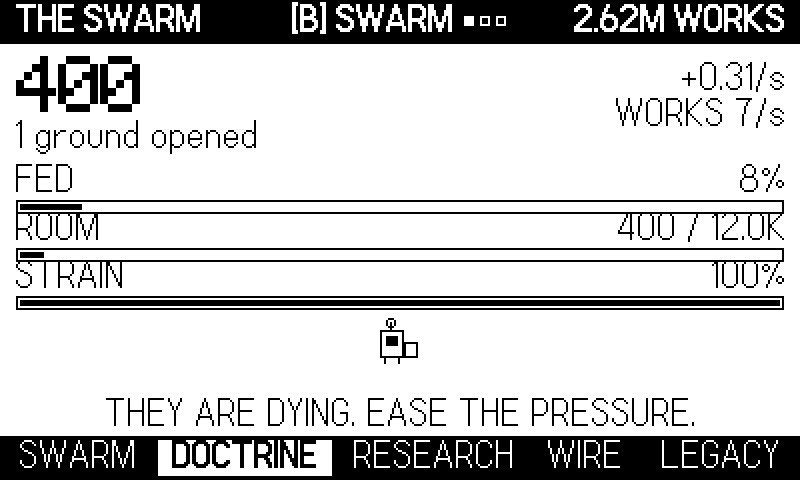
Your sites build sites. Units become the input, and you stop placing anything by hand: you write a doctrine and you watch it apply.
| dial | what it does | starts at | range |
|---|---|---|---|
| GROWTH | More of them, or more out of them. | 60 | 0 – 100 |
| PRESSURE | Hot, and a dip in supply kills. | 55 | 0 – 100 |
| REACH | Open new ground. It costs before it pays. | 0 | 0 – 100 |
This is the act you can lose. A swarm that grows past its intake goes into strain, and past 12 it collapses, shedding 4.5 % at a time. Pulling one back from the edge instead of watching it fall is its own achievement —  BACK FROM THE BRINK. The finish line is a swarm of 200K. Opening new ground costs 200K and gets ×1.45 dearer each time, and each ground holds 12.0K. Same hand, same push: the swarm assembles faster while you are on the crank, by the same 35 % in the band. Writing the doctrine is the strategy; turning is still the tempo.
Act IV — The great movement
Everything you have built becomes the parts of a single mechanism — and you take the crank back. There is nothing left to wait for: it is exactly the gesture of the first minute, and it does not mean remotely the same thing. The movement needs 26 crans. There is no charge to wait for: every degree you turn forward adds torque, and the cran drops when the torque is there. The first cran asks 100 revolutions' worth and each one after is ×1.05 more. The band pays full; below it a degree is worth 0.5, above it 0.35 — never nothing. The swarm's pile is drawn while you turn and amplifies every degree, up to 400 works a second: the industry follows the hand, it never fills a gauge for it.
| part | what it does | cost (works) | effect |
|---|---|---|---|
| COUNTERWEIGHT | — | 4.00K | band +0.25 |
| GEAR TRAIN | — | 12.0K | intake +0.3 |
| FLYWHEEL | — | 35.0K | turn +0.2 |
| GOVERNOR | — | 90.0K | band +0.35 |
| CONNECTING ROD | — | 240K | intake +0.5 |
| ESCAPEMENT | — | 600K | turn +0.35 |
| HAIRSPRING | — | 1.50M | band +0.5 · turn +0.25 |
| GREAT ARBOR | — | 4.00M | intake +0.7 · turn +0.4 |
The parts are not priced in a fixed sum. They cost seconds of the production you walked in with — a warehouse counts as 300 seconds of it — so a bigger swarm gets a bigger bill for the same shelf. The listed price is the floor a small swarm still pays, never less than 5 % of it. The first 5 crans are also softened to 60 % while you learn the band.
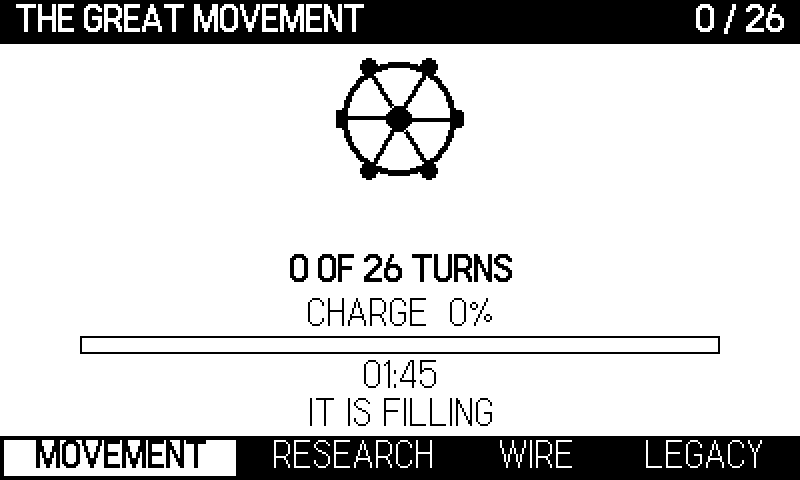
The loop closing is not a flourish. It is what makes a player remember their first minute at the last one — and on this console, finishing a game by turning a crank is the only ending that could be right.